The jar is clear. The view is perfect. And I still can’t see a goddamn thing.
The hamstring went 90 seconds before the gun.
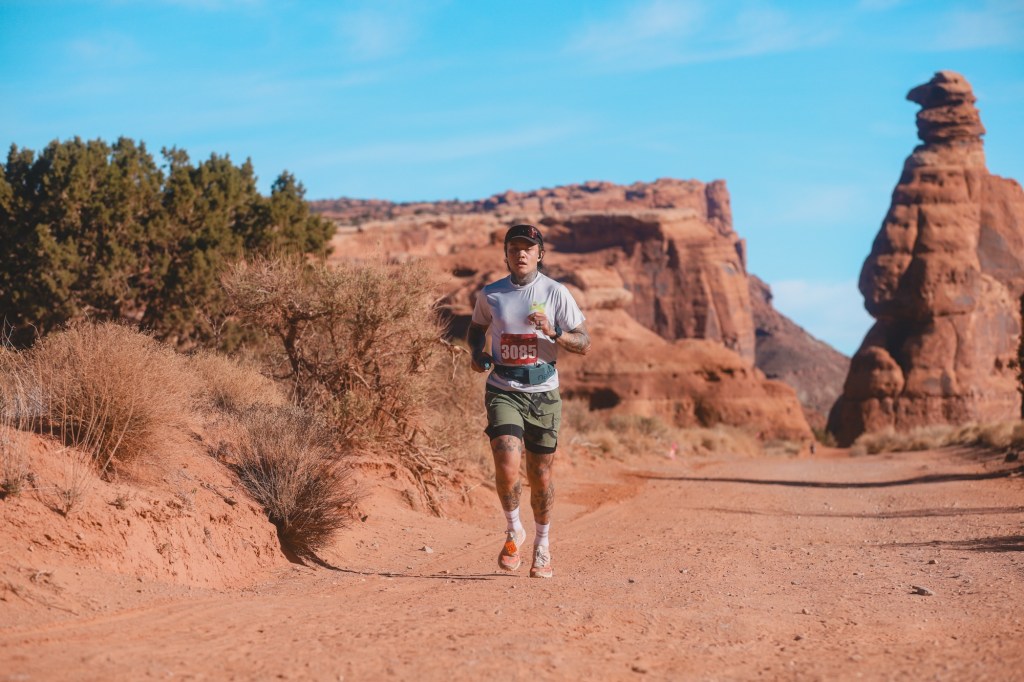
Not during the race. Not at mile two when I could’ve walked it off with some dignity. During the warm-up—a thing I’d never done before a race in my life because I’m not some kind of professional with a routine and a foam roller and a future. But there I was, jogging in nervous circles like a dog before it shits, and my left hamstring said “absolutely not” and seized up like a rusted hinge.
Nothing new on race day, right? That’s the rule. The cardinal rule. And I’d just broken it in the dumbest possible way—by trying to do something responsible for once. The irony wasn’t lost on me. The ability to walk normally was, but not the irony.
I stood there in the red dirt, thirty seconds from the start, testing the leg. It held. Sort of. The way a screen door holds when one hinge is missing. I looked at the starting line, at the other runners bouncing on their toes and shaking out their quads like functional human beings, and thought: Today is going to be weird.
I was right, but not in any of the ways I expected.
The gun went off and I went with it, hamstring be damned. Started hot because that’s what you do when you’re pretending everything is fine. The first mile felt good in that dangerous way where your brain hasn’t caught up to what your body is about to tell it. 11k was an unknown distance, so why not show up and blow up? It was moving well – I started to look around, a beautiful morning, cold burning off. The state route with a gentle passing hum of cars.
Then I looked down at my feet.
Brooks Catamount Barefoot. Near-barefoot, or how they feel to me. The shoes I wear when I want to feel every pebble like a personal insult from the earth. I’d forgotten the carbon plate Nikes—the actual racing shoes, the ones with cushion and spring and a reason to exist on anything that isn’t technical singletrack.
And that’s when I noticed the road.
Fire road. Smooth, wide, boring fire road stretching out ahead like a highway to nowhere. I’d psyched myself up for technical terrain, for rocks and roots and the kind of footing that rewards minimalist shoes and punishes hubris. Instead I got graded gravel and gentle grades, the kind of course that begs for a carbon plate and makes barefoot runners look like masochists with a point to prove.
The mental whiplash was immediate. I’d prepared for the wrong race. Worn the wrong shoes. Strained the wrong muscle. It was like showing up to a knife fight with a pool noodle, except the knife fight turned out to be a bake sale and now I’m just standing here with a pool noodle looking like an idiot.
I laughed. What else was there to do?
Mile three is where the cold set in.
Not weather cold—Moab doesn’t do cold in any meaningful way. This was the other kind. The kind where your legs forget how to fire, where the hamstring that was holding together with duct tape and spite finally sends up a flare that says “we’re done here.” The momentum I’d built in that stupid hot start evaporated like monsoon rain on slickrock.
Burned cold. That’s the phrase. Started hot, burned through whatever fuel I had, and settled into a cold, grinding reality where every step was a negotiation with a body that had already checked out.
The hamstring wasn’t screaming anymore—it had moved past that into a dull, persistent ache that colored everything. My stride shortened. My pace dropped. I watched runners I’d passed earlier come back around me like I was standing still, which, relatively speaking, I was.
This is the part of racing nobody talks about honestly. Not the pain—everyone talks about the pain, wears it like a badge, turns it into content. I’m talking about the boredom of suffering. The tedium of spending miles inside a body that’s failing in slow motion, where every thought is just a variation on “this sucks” and “how much farther” and “why do I do this to myself.”
I settled into the cold. Let it become the baseline. Stopped fighting it and just… existed inside it. Fire road, wrong shoes, bad hamstring, and all.
I finished third.
Third place. Objectively good. A podium spot. The kind of result that should feel like validation, like all the training and the early mornings and the stupid decisions were worth something. And then I saw them.
The college kids. A whole team of them, lined up together in matching singlets, laughing and comparing splits and existing in that easy camaraderie that comes from being young and fast and part of something. They moved like a unit—stretching together, joking together, belonging together in a way that made my third-place finish feel like a participation trophy I’d awarded myself.
I stood there, alone, hamstring throbbing, wearing the wrong shoes, and watched them. Watched what I could’ve had if I’d made different choices at eighteen. If I’d joined a team instead of… whatever it is I did instead. Work? Drift? Drink? Use? Convince myself that being a lone wolf was noble instead of just lonely?
The gut punch wasn’t the physical comparison it was the context. They had a framework. A structure. A reason to be here that extended beyond “I signed up for this in a moment of weakness and now I’m committed.”
I felt old. Not in years—I’m not even that old—but in choices. In paths not taken. In the accumulated weight of decisions that seemed fine at the time but now, watching these kids exist in their easy collective, felt like a slow-motion catastrophe I’d authored myself.
Third place. Alone. In the wrong shoes.
Here’s the thing about being trapped inside your own life: you can see out, but you can’t see through.
It’s like looking through a clear jar. You can see the world outside—the other lives, the other choices, the parallel versions of yourself who made different calls at critical junctures. You can see them clearly. But you can’t see them from their perspective. You can’t know what it actually feels like to be on that side of the glass.
Maybe the college team version of me would’ve been miserable. Maybe the structure would’ve felt like a cage. But I can’t know that. I can only see out from where I am, pressing my face against the glass, watching the other side and wondering.
The jar is clear, but the view only goes one way. And that’s what makes it unbearable—not that I made the wrong choice, but that I can’t ever know if I did. I’m stuck inside my own experience, unable to see what the alternative actually looks like from the inside.


Leave a Reply