Signing up for Kodiak again came with a new kind of nervousness. Unlike previous races, I had set a more specific goal and developed a strategy involving splits. Scary. The shift from just showing up to actually preparing and executing felt out of reach.
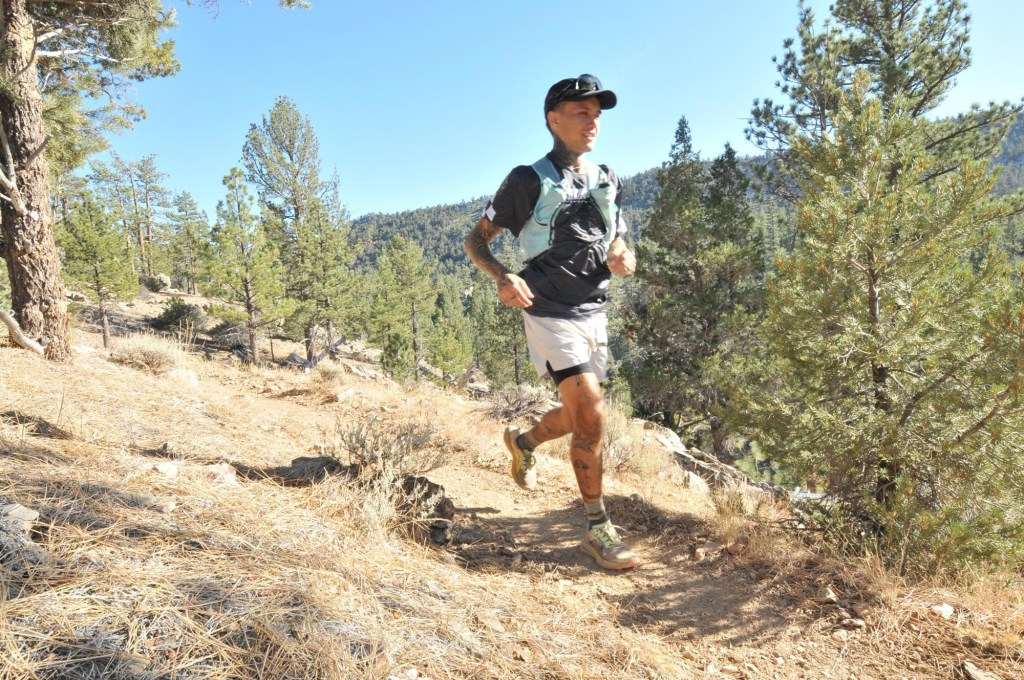
The race was not a garuntee from the start. A large forrest fire was started (by arson) a few weeks out, and the area was ravaged. A tremendous effort was put forth from cal fire and the race course was reset and was able to happen on time but on the other side of the lake.
My history with “performance,” during active addiction was pretty straightforward – I’d arrive unprepared, take whatever risks presented themselves, and let chance determine the outcome. It was a familiar approach that required little forethought and kept me in a safe place. It is easy to just show up and not really hit a mark that doesn’t exactly exists it. It is hard to put it down on paper, what your going for, and create the potential for a failure.
The support system was solid this time around. My wife and a good friend agreed to crew, I had guidance from a coach, and the encouragement was coming in from all angles. I landed on a goal time of 9 hours and 15 minutes. It seemed ambitious but not impossible with proper execution. Like floating a raft out onto a clouded race, not sure exactly what was out there, but hoping there was water.
I got to Big Bear early to acclimate and settle in. By race morning, I felt reasonably prepared, though a familiar edge of uncertainty remained. The preparation helped, but questions still lingered.
The start was quick. Much quicker than I anticipated. I found myself near the back of the front pack for the first three miles, ahead of schedule. A big goal on the day was to stick to the script and not get carried away. Reality set in, and I made the conscious choice to ease back, watching several runners pass as I dropped from around seventh to around twentieth position.
After clearing the first aid station, things began to click. The field stretched out along the trail, and I finally found myself running at my own pace. The rhythm felt right, matched the training, made sense.
The first section of the course comprised of two loops creating a figure eight. I enjoyed these largely on my own, seeing a runner occasionally. I was taking in the correct amount of calories and getting in more water than normal to account for the elevation.
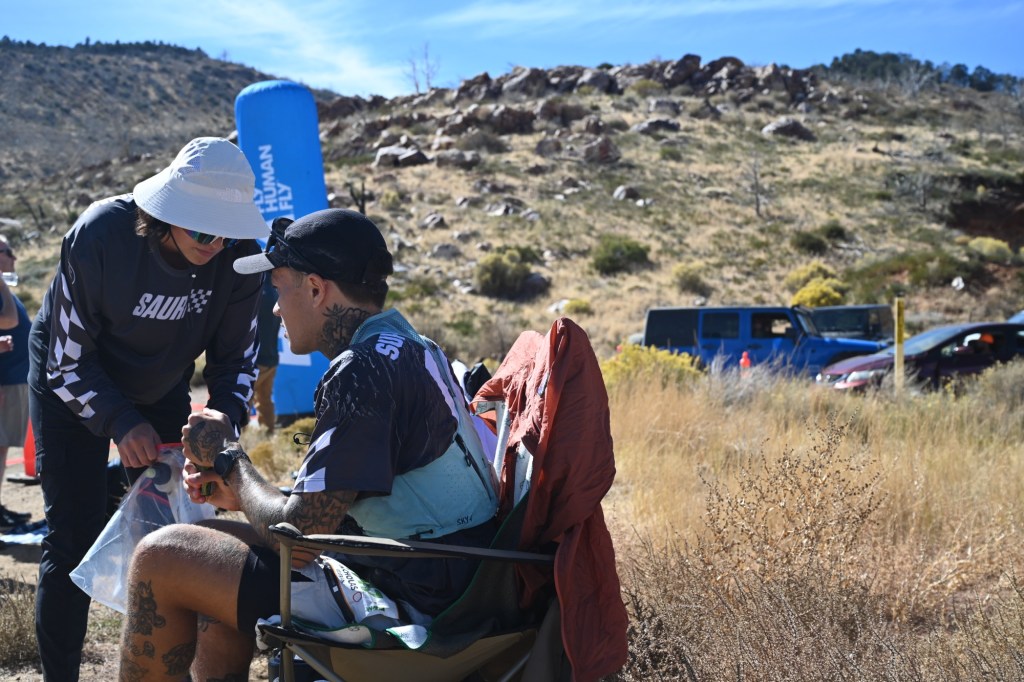
As I emerged from the first section, the race field had transformed into organized chaos. The convergence of distances – 25K, 50K, and 100K runners all sharing the same strip of trail – turned position-tracking into a puzzle. Bibs of different colors streamed past in both directions, making it impossible to know who was racing what distance or where I actually stood in the 100K field.
The course opened onto a dirt road section, the hard-packed surface offering a chance to find an even faster pace. Through the 50K mark, everything clicked – nutrition on schedule, pace dialed in, body responding well. Approaching the first crew-accessible aid station, I had methodically worked my way past several runners. The split times confirmed what I felt: just two minutes off target pace after 31 miles. My wife and friend moved through our discussed routine with precision – fresh bottles, new fuel, pickle juice, sun screen. Their efficiency matched my focus, and I left the aid station with growing confidence in the plan.
The unraveling started subtly. The same legs that had carried me smoothly through about forty miles began to send warning signals – small twinges at first, then a deepening heaviness that seemed to seep into every stride. More concerning was the familiar churning in my stomach, a sensation I knew too well from other ultras. What started as mild discomfort grew more insistent with each mile. The carefully calculated nutrition plan that had worked perfectly for hours suddenly felt like a liability.
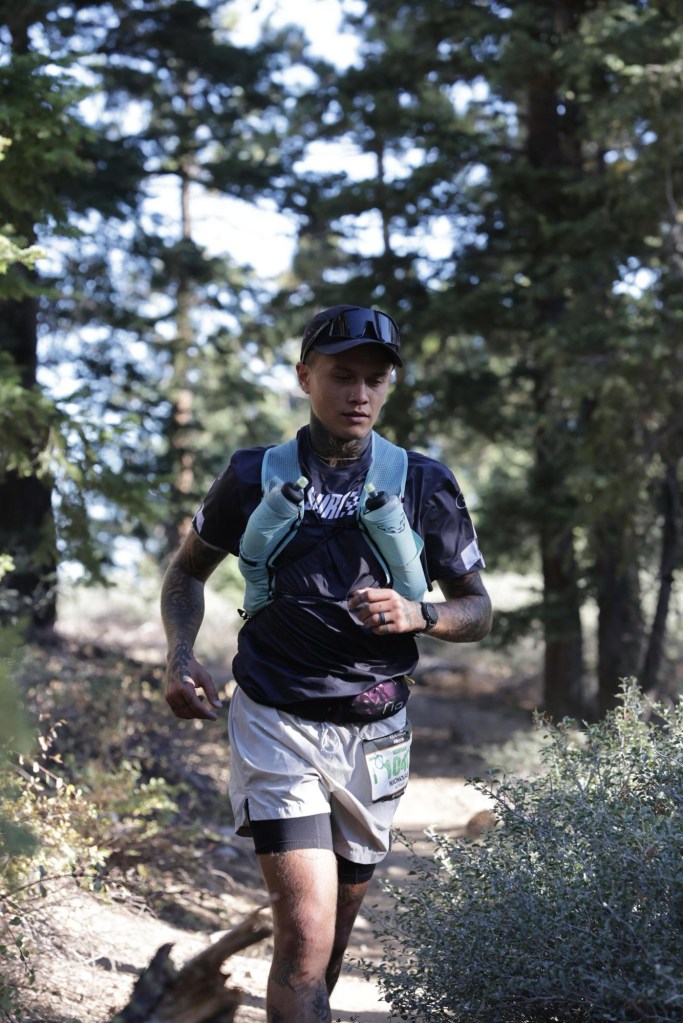
The contrast was stark: less than an hour ago, I had been executing the race plan with almost mechanical precision. Now each step required negotiation with increasingly rebellious muscles and a stomach that threatened mutiny. The margin for error I had built through careful pacing was beginning to erode, not from pushing too hard, but from the simple math of what happens when the body starts to reject calories at mile 35 of a 62-mile race. Each time I introduced anything with caloric value my stomach attempted to send it back up.
The turnaround aid station on the out and back section materialized like an oasis – mile 44.5. I went through the motions: refilling bottles, grabbing ice. The return journey started with a climb up the decent we just came down. The grade wasn’t particularly steep, but at this point in the race, every incline felt magnified. I broke it down into segments, running the whole way back up. Somehow, my legs started to respond. The shuffle became a rhythm, not smooth but sustainable.
Seeing my crew at about mile 50 changed everything. Their efficiency hummed again, the other ready with nutrition and stats. The cold water cascade over my head cut through the accumulated fatigue, shocking my system back to alertness. The aid station split sheet showed I was still within striking distance of my goal, having made up several minutes on the climb. Twelve miles remained – a distance I’d run hundreds of times in training, but never quite like this. I was yet to be running still this late in a race.
The next section opened with another sizable climb up single tack. Surprisingly, my legs had life. The consistent training on similar terrain started to show. My stomach, which had been a constant source of concern, seemed to stabilize for a bit. Still rejecting the calories but not trying to force them out as aggressively. The nutrition plan was working again: small sips of drink mix every 15 minutes, salt tabs on the hour to half hour. The summit came into view, and with it, a glimmer of hope.
That hope lasted exactly 400 meters past the crest. The collapse was sudden and absolute. My stomach twisted violently, the kind of pain that stops you mid-stride. I stumbled off trail, barely making it behind a scrub oak. What followed was the kind of physical purge that ultra runners rarely discuss but intimately understand – a complete system reset that left me hollow and shaking.
Getting vertical again took three attempts. Standing there, I did the math: I had burned through roughly 6,000 calories so far, and my body had just forcefully ejected what little remained in my system. The finish was still seven miles out at least. I fumbled with my vest, trying to take stock: two gels, one salt tab, half a drink mix. I attempted a small sip of water. Thirty seconds later, it came back up. Another attempt five minutes later – same result. The energy meter wasn’t just on empty; the gauge itself seemed broken. Running was more of a stagger and it felt impossible to run uphill so I was set power to hike the climbs to avoid passing out. The word spun. I tired to keep pumping in water and calories, but needed to stop several times to expel whatever little was sitting in my system.
Each step became a fight between what my mind wanted and what my body would allow. The trail ahead stretched out in a cruel optical illusion – every bend promising relief but delivering only more distance to cover. The consistent 8:45-8:30 minute miles from earlier had deteriorated into something much slower, each split time a reminder of how quickly things can unravel in the late stages of an ultra.
The three-mile marker appeared just as the trail merged onto Big Bear Lake’s North Shore single track. My watch showed 10 hours and 13 minutes – the original goal was long gone, but something else had taken its place. The smooth dirt surface offered one last opportunity, and I made the calculated decision to burn whatever matches remained.
Years of addiction had taught me about pain, about pushing past reasonable limits. This was the same, just packaged differently. Pushing towards instead of away. A conscious choice to embrace discomfort rather than escape it. I shifted my cadence, shortened my stride, and started to pick off the remainder methodically. The watch beeped: 8:52 minute mile. Then 8:45. Numbers that shouldn’t have been possible after 59 miles of mountain terrain and complete system failure. I got it down to 7:00 minute and then 6:30 when my feet hit pavement.
The finish line setup emerged around the last bend – UTMB’s signature blue arch standing stark against the mountain backdrop. The timing mat was 400 meters out. When you close in on a finish line things seem to go black a bit. There is noise, but it is indistinct. You can feel the pains but they are far away, as if you are observing someone with those sensations. Not yourself.
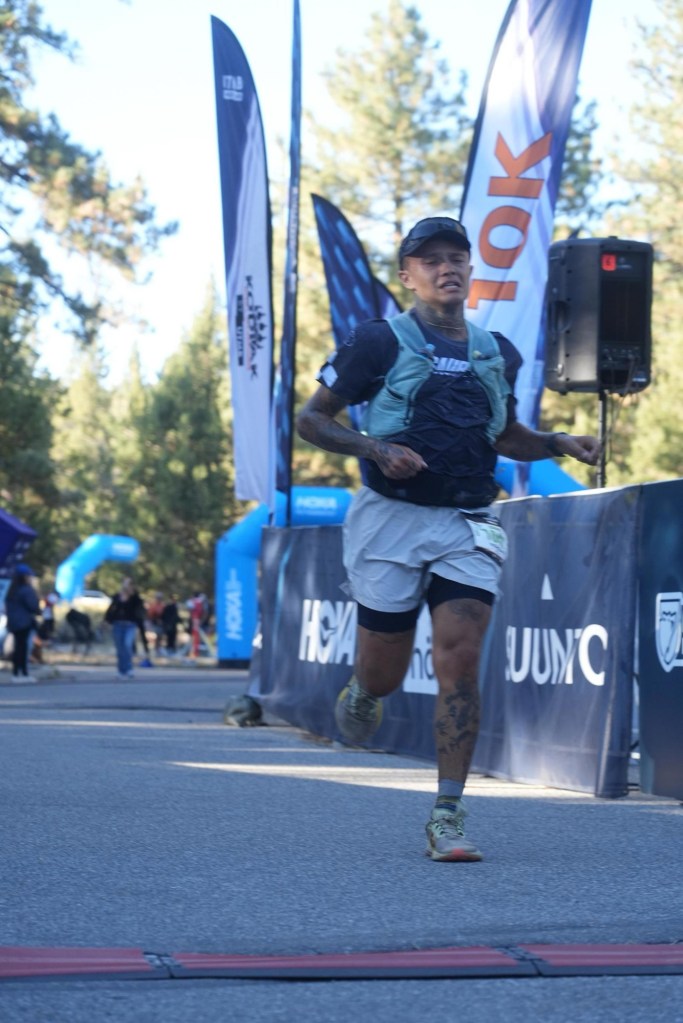
I crossed under the arch at 10 hours and 47 minutes, hands on knees, vision narrowing to a pinpoint. I crashed onto a curb. My crew appeared, steadying me as the world came back into view. What had just happened a distant idea. On the day of I showed up as the tenth place male finisher. That was later adjusted to 11th that seems. I hold onto the tenth in my heart a bit however, as that is what I saw when I my wife showed me her phone on the shuttle back to the cars.
Nearly 11 hours of mountain running had produced something beyond just a finishing time. It was validation that preparation could coexist with passion, that structure didn’t have to diminish intensity. The result wasn’t what I’d originally aimed for, not even close, but it represented something more valuable: proof that I could show up for myself ready and aim high. I would be there on the other side.
 Bonk and Rally
Leave a comment