After a humbling start to ultra trail distances, I decided it was best to drop some mileage and see how twenty miles less would suit me. The next venue was another California race in the Big Bear area, the Kodiak 50K. I decided to sign up for this race about a month after finishing the Bishop 50-miler. Although I felt somewhat beaten by the 50, despite finishing, I found some renewed fire to give this race a good try. I placed new intention on more deliberate training to fit the race profile and tried to develop some sense of balance with my nutrition. I also refused to sleep in the van for two hours before the start line this time around.

I was living in Oregon for the summer and found a nice rhythm to getting on the trail there. The training was not elaborately thought out by any means, but it was consistent in a way I had not achieved before. I found myself naturally getting into more vertical weeks and starting to understand more and more what it meant to “run” on trails. My attention to stats started to improve, and I fell into the world of heart rate and zone training. Being more deliberate in taking runs easy was hard for me, but I started to see results as my more intense efforts felt more sustainable. The idea of a “long run” extended and added hours. All of this training was still fully off of feel and a prayer.
As the summer turned to fall, we returned to LA. The transition to the SoCal area was smooth as I swapped the Cascades for the San Bernardino Mountains. More vertical and more heat. I started to speed up and made a fatal turn in my training. The gains I had felt from the slower efforts had started to show up, and I got fixated on the feeling of going fast. My training efforts got shorter and shorter, and the intensity went up and up. I was particularly fond of a route in Griffith Park, and my addictive tendencies landed me there four or five times a week, slamming up a climb and blasting a descent. It felt great, and in my mind, the training was working. I was not tracking much data at this point or keeping up with weekly mileage or vertical gain.
As the 50K neared, I attempted a taper and was successful in this. I also splurged a bit and rented a place for a night or two before the race to acclimatize and avoid a similar near all-nighter crashing in the van. This, however, provided me more room to make mistakes while waiting for the race to start, and I took full advantage. The night before, I did what I thought was a carbo load and made a large noodle and vegetable dish. I ate beyond being full and thought in my mind I was all set.
Toeing the line in the dark before the race start, I was not very nervous. I felt assured that I was well-trained and optimistic I would do well. I did not have a time or position in the race in mind for what that meant, but I just thought it would go well. My vest was loaded to the brim with two full flasks, some gummies, and other random nutrition bits. I hadn’t put as much time into that aspect as I should have, it turns out. I started towards the middle or back of the pack. The course started onto a road leading out of town, then transitioned to a double-wide and then single-track trail. I worked my way through the queues of people and found a rhythm. I was feeling strong and grounded, with plenty of energy and ready to rock. I laid off the gas.
As I entered another single-track section, a blaze shot past me. I didn’t understand at first, but as more people came sprinting by, I started to get the picture that they were running the same race. Initially, I thought, “No way, they are going way too fast to be in a 50K,” but as they just kept coming, the reality set in. I panicked. All of a sudden, I felt pressure to get moving and found my comfortable pace too slow. As I hit a steep climb on the road that many people were walking, I turned on the gas and motored up it. My heart rate spiked, and I was breathing heavy. I crested and kept up a similar pace going down winding single-track, passing people consistently on my way. The downhill flattened, and I kept a similar effort up, pushing on the flat. I was not at a tempo, but I was moving faster than I thought was a good idea. I felt good, however, and tried not to think about it.
A steep climb up the ski slope stopped my attack. I assumed a power hike in a conga line, caught my breath, and got some nutrition in. Halfway up the climb, I thought, why not, and pushed again. I got to the top and rolled into the aid station. I put down a ginger ale as a preventive measure, grabbed some random nutrition, and kept moving. I took on a similar pace, pushing through more downhill. As the single track rolled on with small punchy climbs, my knee started speaking to me. I had barely had an issue with it since the 50-mile race. I slowed down and tried to settle back. The knee let up as I moved through a few more miles.
The terrain evened out, and I was feeling more comfortable with my station, not knowing exactly what that was all the while. Seemingly out of nowhere, my stomach lurched. A tightening and pain I hadn’t felt since the 50-mile race returned. I knew it wasn’t good news, but I tried my best not to think much about it. The more I neglected both problems, the more they rose in concern. The knee pain continued to climb slowly, and the stomach continued to ache more and more. I pressed on and continued to run. The course itself was stunning, and the trails were immaculately taken care of. Although I was in pain I found a great deal of relief from my physical experience through adapting mindful practices to my environment. I paid extra attention to colors, scents, and textures. I tried to be curious with these sensations, no matter how boring it was. Inevitably I would get distracted, but if I got into a rhythm with this type of thinking I get a good chunk of time where I felt aligned with my pain, not opposed to it.
I got through half of the race, and by then, my stomach was slowly getting better. With the knowledge I have of my metabolism and general race nutrition, I believe I had essentially created a funnel in my digestion with the mass amount of carbs I had put in the night before. My body was not used to that and was also not able to move all those calories efficiently. Thankfully, sometime after mile 15, the bulk had been processed, and I was able to move with a little less strain. My knee, however, continued to persist with pain. I had brought a knee brace with ice, which helped a good deal during this race.
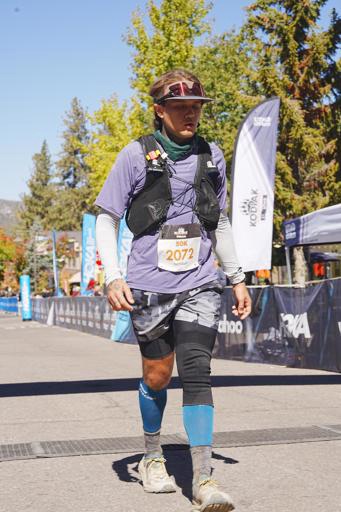
I still did not check any stats while running and actively tried to look away when mileage signs were posted. However, I was relieved when, near the top of a climb, a sign indicated there were only three miles left. This came as a genuine surprise, and I finished the race feeling strong. I also consistently throughout the race wondered why I had so much gear in my vest. Routinely I would bring a tiny stuff sack with me on training runs with basic first aid, which I brought on course and never touched or thought about aside from how I was carrying extra weight. Also it is clear in the picture how bulgining my vest was at the end of the race. Frantically at aid stations I would jam a random assortment of GU’s and snacks in my vest, and would continue to do so even when my vest was full. Aside from leaving me with some unused nutrition to take home and use in my next training run this did essentially nothing for me. I crossed the finish line in just over seven hours. This did not feel fast or slow with that for me, but once again, it did feel strong, which I was grateful for.
 Bonk and Rally
Leave a comment